Kilcullen Science and Engineering

Showing posts with label biology. Show all posts

Thursday, July 23, 2026

How To View What's Behind Your Washer Drum

Inside of a washing machine drum
© Eugene Brennan

You can check what's between the inner and outer drums of a washing machine, or check for limescale build-up on the heating element, by spinning the drum and illuminating it with a bright torch.

Sunday, May 17, 2026

It Came From Outer Space....

Jrlly fungus on gravel
Nostoc commune (Latin name), also known as "jelly fungus". © Eugene Brennan

 Well not quite. This is probably Nostoc commune (Latin name), also known as "jelly fungus", "star jelly" or "witch's butter". It's not actually a fungus, but a colony of bacteria. There's loads of it in a patch on my yard, but it sometimes grows on lawns. It's extremely slippery on a lawn. Apparently it's eaten as a salad in the Philippines when dried out. I'm a fussy eater so I won't be trying it anytime soon.

More information on jelly fungus here on Wikipedia.

Thursday, January 29, 2026

Top 100 Cool Science Facts for Kids!

Title image of article showing the Earth in a hand
Photo courtesy Geralt on Pixabay. Text overlay © Eugene Brennan

Why is the sky blue? 

What is air made of? 

How many stars are there? 


World of wonder fun science facts that every child should know! This article covers space, nature, technology, engineering, elementary mathematica, chemistry, physics and biology.
Science is fascinating and tries to explain how everything in the world and outer space works. Science gives us the answers to questions like "What is electricity?" and "How does an aeroplane fly?" Read on and learn 100 more cool science facts! 

Sunday, January 25, 2026

Super Human Strength and an Injury on Church Mountain

Fence on a mountain
Fence on Church Mountain, Co. Wicklow. © Eugene Brennan

In 2019 I was making my way down a gully on Church Mountain near Hollywood with my bike slung over my shoulder. I had cycled half-way up on the trails at the back of the mountain and was going to go further, but it was getting late in the day and I decided it would be wise to head home before it got dark. The gully was peppered with lots of rocks, covered in wet, slippery moss and algae and difficult to navigate. I was distracted by an annoying off-lead dog belonging to walkers behind me which kept barking at me. I lost my concentration, slipped and started to fall backwards, my bike pulling me down (which is why it's never a good idea to carry a ladder over your shoulder on a stairs).

Friday, June 20, 2025

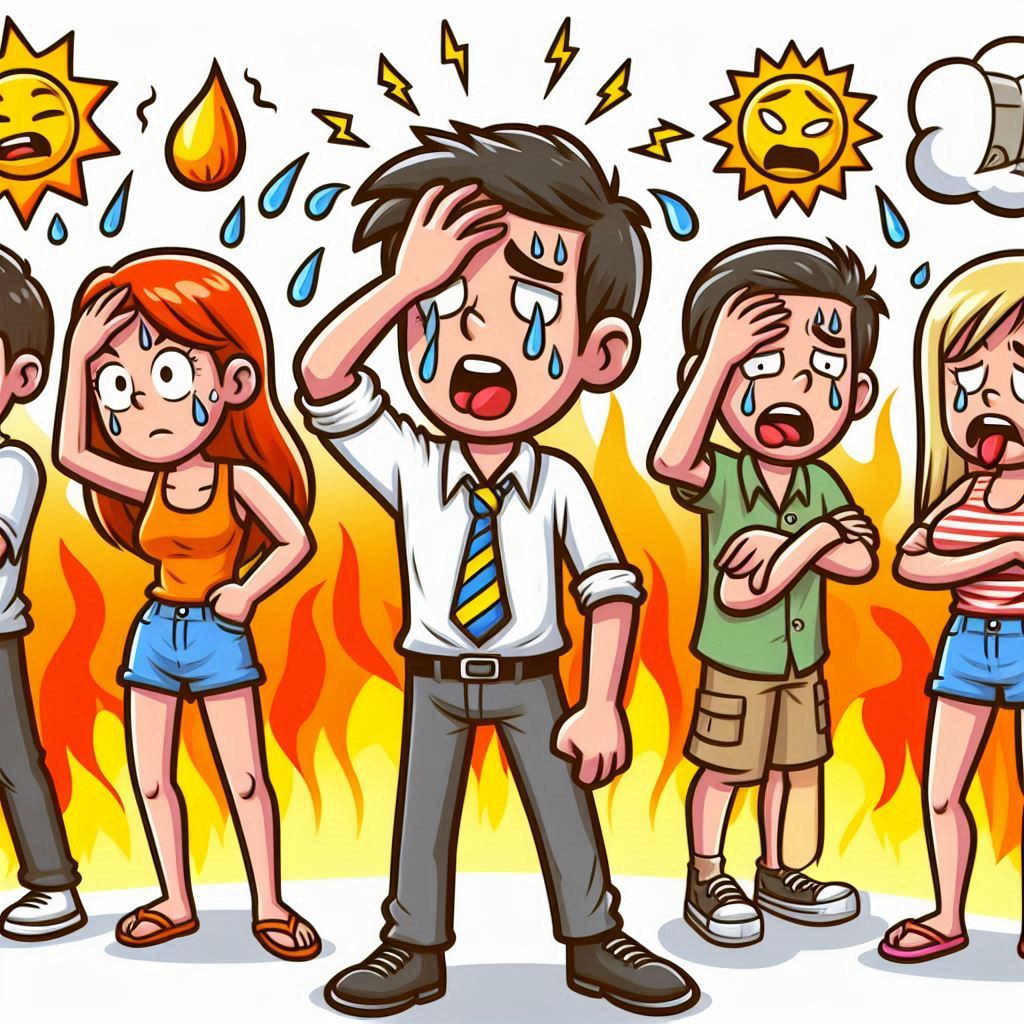
Why Does a Hot Day Feel Hot?

Generated with Bing Image Creator.
Did you know that it's not just high temperatures that makes us feel hot on sunny days in the summer? 

Normal skin temperature for an adult ranges between 33 °C and 37 °C. Our bodies are cooled naturally by perspiration that's released from pores in the skin. When sweat evaporates, it carries away heat from the body, reducing skin temperature. Capillaries in the surface layers of the skin also help with cooling by circulating blood, which also loses heat to the ambient air. Anything that interferes with this process changes the perception of how hot or cold it is at any one time. So higher humidity reduces the rate at which perspiration evaporates, making it feel clammy and warmer. A less humid day doesn't feel as warm, even though the temperature may be the same. Air movement also increases the rate of heat loss from the skin. So a windy day feels colder than a day when the air is still. The air blown out of a room fan feels cold. Fans don't actively cool air — air conditioners do. The air they circulate is at the same temperature as the air in the rest of a room. They simply remove air that has been in contact with skin and has absorbed heat from it. They do this continuously so new air is always moved into contact with the skin. Since this "new" air is at room temperature and not warmed, heat flows at a faster rate from skin. The reason for the greater rate of heat transfer is because heat flows from a region of hot temperature to one at a lower temperature. The greater the difference in temperature, the higher the rate of heat flux. And so this cools our bodies faster than natural cooling. Blowing on hot soup in a spoon does the same thing.

Friday, April 18, 2025

From the Wikipedia Rabbit Hole Day Trip: Bacterial Cellulose

Lightenoughtotravel, Public domain, via Wikimedia Commons
The equivalent of cellulose in other plants (e.g. wood formed from lignin fibres in trees), but made by bacteria. So just like plant cells have a cellulose shell to give them protection and structural integrity, bacteria have something similar. I ended up on this page because I was reading on a homemade tools group about how someone had used the stuff in the same way leather is used, for strapping two parts together. Bacterial cellulose has certain desirable characteristics such as greater tensile strength than plant cellulose and large hydrophilicity (attraction to water) and so may be useful in biomedical applications.

More info in this Wikipedia article.

Sunday, March 16, 2025

Hear Today, Gone Tomorrow

Public domain image courtesy Pexels.
Remember when you were young and could hear the high pitched whine of the horizontal line scan transformer in a TV that was using the 625 line system? The line output or LOPT transformer operated at 15,625 Hz, and you could tell that the TV was turned on, even with the sound turned down. Before that in the early 70s, vertical resolution was 405 lines. Young children can hear up to a frequency of 20 kHz. Most of us over 50 can only hear to 10 kHz.

Wednesday, February 26, 2025

Fungi Using Gamma Radiation in Chernobyl

Image generated by Bing Image Creator.

Plants perform photosynthesis, using their leaves to convert light energy from the Sun, water and CO2 into stored chemical energy in the form of starch and sugars (which we can eat, e.g. potatoes, corn etc). O2 is produced as a waste product. The captured carbon is also used for growth and all the structure of a tree comes from CO2 in the air, not from the ground. This article from the Royal Society of Biology explores the radiotrophic fungi from Chernobyl, discovered in the late 1980s, that appeared to have been using gamma radiation for growth. Gamma radiation is a type of electromagnetic radiation, produced during atomic decay. It's on the same EM spectrum as light, UV, infrared, radio waves and X-rays, but has a much higher frequency and shorter wavelength.
This article in The Biologist, the  journal of the Royal Society of Biology has more information.

Tuesday, February 04, 2025

Eye See: How Our Brains Hide Some of the Things We See.

Diagram of the eye, naming its components.
Artwork by Holly Fischer, CC BY 3.0, via Wikimedia Commons

I was at the opticians on Thursday for my two-yearly check-up. The optician was showing me the image of my retina on the computer and pointing out the salient features: the blind spot, the macula and fuzzy parts of the image due to floaters. The blind spot is the region of the retina where the optic nerve connects all the rods and cones to the brain. Cones are structures in the retina, responsible for sensing colour in the daytime, and rods are more sensitive for night vision, but they can't discern colour.
The macula is the area of the retina that has the highest concentration of rods and cones. It's located towards the centre of our vision and what allows us to see greatest detail. When people develop a disorder called macular degeneration, the function of the macula is degraded, making it more difficult to read and perform other tasks. If you hold your thumb in front of your eye, blocking your central vision and try to focus on text in the distance, but not looking directly at it, you'll find it difficult to make out detail and read the text.
Floaters are pieces of debris, the remains of cells, floating about in the vitreous humour, a gel-like material that fills our eyeballs. If you try to look at them, they flick into the centre of vision, then slowly sink again.
The eye does the mechanics of converting an upside down image focused on the retina into an electrical signal and sending it to the brain, similar in principle to the charge coupled device (CCD) sensor in a digital camera. But that's only part of the story. Perception is something done by the brain, effectively "projecting" what we see onto the equivalent of a cinema screen. But what appears on that screen isn't exactly what's "out there" and not a one-to-one mapping like what would happen on a television or cinema screen. For starters, the image on the retina is upside down, so that has to be turned the right way up. We think we see a high resolution image of what's in front of use, but our eyes are really scanning a scene, building up a collage of images from the macula, so that makes a sort of composite image that our brain remembers. We can't see anything from the region of the retina where the optic nerve joins it, so the brain "fills in" that blank spot in the image we perceive. What's most amazing I think is how we don't see the blood vessels in our eyes. They're visible in the retinal image taken by an optician, but our brain does something like the post processing used in movies to remove wires that support flying actors. If you look at the ceiling just as you wake up and open your eyes, you can sometimes see the blood vessels as black lines, like the roots of a tree, for a split second before your brain kicks in and removes them. The optician hadn't experienced this phenomenon, but said she'd look out for it. Optical illusions are another quirk of perception where what we see isn't necessarily what's out there. Two illusions are worth checking out, including the checker shadow illusion and the simultaneous contrast illusion.

Thursday, December 26, 2024

46,000 Year Old Frozen Worms

Nematodes. Image courtesy CSIRO, CC BY-SA 3.0 via Wikimedia Commons.
Your freezer doesn't kill germs like high temperatures in an oven does, it only slows down their metabolism so the reproduce more slowly. One of the the reasons germs are a hazard is because they manufacture toxins as waste products. Therefore, even cooking food at normal temperatures that has "gone off", while killing the germs, doesn't necessarily render those toxins harmless. If you've ever put tomatoes or other watery food in a freezer, you'll know that they become mushy when thawed. That's because all living things are built from cells, just like Lego. The cells are like capsules of water which burst when water expands on freezing, causing a loss of structural integrity and limpness in a fruit such as a tomato (Is it a fruit or veg? That's another argument!). Half-hardy flowers such as petunias are damaged by frost for the same reason, but hardy flowers have "anti-freeze" in their cells. This prevents the cellular fluid from freezing at low temperatures, so the plants can withstand severe frosts. Possibly this is the mechanism by which this worm survived 46,000 years in permafrost, having evolved and achieved this survival technique.

Tuesday, November 26, 2024

Structural Colour and Iridescence

A green bottle. © Eugene Brennan
A species of green bottle I think. Sorry quality not the best. Normally the way colour works is that if an object is illuminated by light, pigment in the surface absorbs some wavelengths and reflects others. The Sun mostly produces broad spectrum white light, so a red rose looks red because it absorbs all the colours of the rainbow in white light and only reflects red. Some animals, insects and plants have evolved so they can produce structural colour on their body's surface which doesn't rely on pigments. Instead, the topography of the surface is such that tiny elements like ridges or other structures, having dimensions comparable to the wavelength of light, produce iridescent colours. Iridescence is a phenomenon that makes soap bubbles, oil spilled on a wet road, opals and the underside of CDs look colourful. It's caused by wave interference where waves of light combine and the peaks and troughs add or subtract from each other to reinforce certain wavelengths, making colours emerge from white light. Beetles, blue and green bottles, some butterflies and starlings are examples of animals that use iridescence. The theory is that it confuses predators or is used for communication.

Tuesday, November 05, 2024

The Inkcap Family Out for a Stroll

Common inkcaps. © Eugene Brennan

Mammy, daddy and their young child. Spotted down my back garden.
Well not really, these are common inkcaps. Mushrooms are the fruiting body of a more extensive sub-surface fungal network, composed of thread-like mycelia which bore into rotted vegetation. Fungi reproduce from spores that drop out of the fin-like gills on the underside of a mushroom's cap.

Monday, September 16, 2024

BPS Podcast - Not Just a Phage

Image courtesy Guido4. CC BY-SA 4.0 via Wikimedia Commons

We don't really know what life is. The best scientists can do is describe the attributes of living organisms, the most obvious and superficial being that they seem to have purpose in their actions, they eat or absorb nutrients from their environment and they reproduce.
Are advanced AI systems or even your phone "alive"?
Robots of the future will probably be incredibly complex and already some robots are autonomous meaning they can be given a general task and can go off and work out how to do that themselves. The Perseverance rover on Mars is semi-autonomous and has purpose, its task being to search for evidence of past microbial life. While not reproducing biologically, future robots may be capable of replicating themselves using raw materials they source. But does that make them alive? Single celled organisms like bacteria "feed" by absorbing nutrients through their outer walls or cell membranes. Bacteria are thought to be living because they satisfy the criteria for life. However the jury's out for viruses as they can't do anything useful on their own and simply consist of virus particles called virions, made from strands of RNA or DNA. To reproduce, they must infect a host cell, causing the machinery of the cell to make thousands of copies of the virus which then emerge to infect more cells. Bacteriophages or simply phages are types of viruses that infect bacteria and archaea (single celled organisms without a nucleus). Treatment of diseases with phages that could destroy infectious bacteria was a practice once used in the early part of the 20th century but the development of new antibiotics over the decades meant that phage treatment was sidelined. However the appearance of antibiotic-resistant bacteria (something predicted by Alexander Fleming who discovered penicillin in 1928) in the late 20th century and the slowdown of discovery of new antibiotics prompted the WHO in 2017 to highlight the need for new approaches to treating disease.
In this Big Picture Science podcast from the SETI Institute, the team investigate bacteriophage treatment to combat the antibiotic crisis.

Thursday, September 05, 2024

Long COVID

Graphic by Ian Dennis - http://www.iandennisgraphics.com. File is licensed under the Creative Commons Attribution 4.0 International license.

I totally lost my sense of taste and smell in early 2020 when there were only a few known COVID-19 cases in Ireland and loss of taste wasn't one of the recognized symptoms. It was before home test kits were readily available and I never had a test that confirmed I had COVID, but the general belief is that the disease had been circulating in Ireland from the previous autumn. I had no other symptoms and slowly regained my taste and smell over 10 days or so, but it never fully recovered and I still can't properly smell or taste many things, one of which is chocolate. That's understandable since chocolate and coffee are a complex cocktail of hundreds of chemical compounds and I probably lost sensitivity to lots of those. In this article in The Conversation, Ziyad Al-Aly, Chief of Research and Development, VA St. Louis Health Care System and Clinical Epidemiologist, Washington University in St. Louis writes about long COVID and how it affects the body. 


Monday, April 29, 2024

5 Live Science Podcast — Artificial Pancreas

Image © Eugene Brennan

This week's program featured a segment about an "artificial pancreas" for Type 1 diabetes sufferers, which uses a closed loop control system to monitor blood glucose and administer a dose from an insulin pump.

What's a Closed Loop, Negative Feedback Control System?

Many systems use close loop control with negative feedback to control an output of interest. An example is the speed control on small engines, e.g. the one on your petrol lawn mower. If you run into longer grass, this slows down the blade and engine. To reduce the change in rotational speed (the output variable) and keep it at a setpoint (typically 3000 RPM for a mower), a governor is used. A vane, mounted adjacent to the engine's cooling fan that's integral to the flywheel, forms part of the governor mechanism. When the fan slows down, it blows less air onto the vane. The vane is connected via a linkage to a butterfly valve in the carburetor. This valve forms part of the throttle mechanism and as the valve opens up due to movement of the vane, more air/fuel mixture enters the engine. This generates more power which tends to compensate for the slowdown of the blade due to the long grass. Other systems use negative feedback and closed loop control, e.g. your phone charger which has electronics to keep the output at 5 V DC, irrespective of load. Without a voltage regulator, all power sources, including batteries, experience a voltage drop as they're loaded and more current drawn from them. Voltage stabilisation by a regulator is necessary so that the electronics in your phone for instance works in a predictable manner. Other examples of feedback control systems are servos on vehicles and aircraft and temperature and pressure control in industrial processes.

Why Negative Feedback and Not Positive Feedback?

The function of a feedback control system is to keep an output variable at a fixed or variable setpoint, irrespective of load. So in the lawn mower example the speed was the parameter that needed to be kept stable. In negative feedback, the actual speed is fed back and subtracted from the desired speed (the setpoint) to create an error signal. This error, via a controlled variable, drives the system in a direction to bring the output closer to the setpoint. In the lawnmower example, the controlled variable was the fuel. The term negative feedback comes from the subtraction that's involved. Positive feedback on the other hand causes the fed back signal to add to the set point, resulting in instability and the output diverging from a setpoint (e.g. positive feedback in a PA system, causing the squealing from loudspeakers). Many of the systems in our bodies are negative feedback control systems and like any control system if not tuned properly, there can be oscillations and instability. Hence the wobbling from side to side when we're learning to ride a bike!
 

×

Posts by Category